

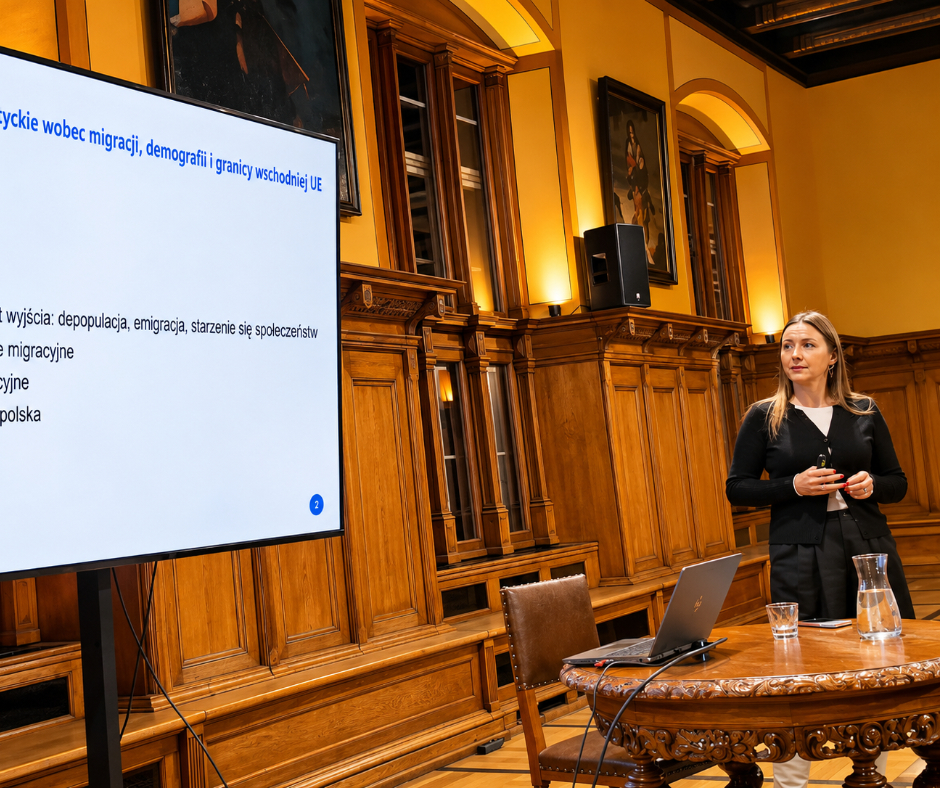
On 12 November 2026, a debate entitled ‘The Baltic States and migration, demographics and the EU’s eastern border’ took place at the Old Town Hall in Gdańsk. The meeting was chaired by Dr Kamila Kowalska, an expert at the Migration Observatory of the Centre for Sustainable Development at the University of Gdańsk.
Lithuania, Latvia and Estonia joined the European Union in 2004, alongside Poland. In the years that followed, all three countries experienced mass emigration, whilst at the same time grappling with falling birth rates and ageing populations. The starting point for the November lecture was the question of why the migration situation in each of these countries looks different today.
Since 2019, more people have been arriving in Lithuania than leaving it. Lithuanians are returning to the country, whilst people from Belarus and Central Asia, amongst others, are taking up employment there. In Latvia, returning citizens also account for a significant proportion of those arriving, although more people are still leaving the country than settling there. In Estonia, meanwhile, 2025 brought a change after a decade of positive net migration – for the first time in ten years, the number of departures exceeded the number of arrivals.
“The migration policies of Lithuania, Latvia and Estonia clearly reflect the need to reconcile economic needs with security challenges,” emphasises Dr Kamila Kowalska. “On the one hand, the Baltic states, grappling with labour shortages and unfavourable demographic trends, need labour migration. On the other hand, in the face of a tense geopolitical situation, they are tightening regulations on the entry and residence of foreign nationals, particularly citizens of Russia and Belarus. Migration there is therefore not only an economic and social issue, but also a key element of security policy,” adds the expert.
The lecture also covered migration policy and the approaches each of the three countries takes to the integration of minorities. A separate topic was the situation of Poles living in Lithuania, Latvia and Estonia.
The event was organised by the Baltic Sea Cultural Centre in Gdańsk and a partner in the ‘Multicultural Pomerania. Multicultural Baltic’ series – the Migration Observatory of the Centre for Sustainable Development at the University of Gdańsk.