

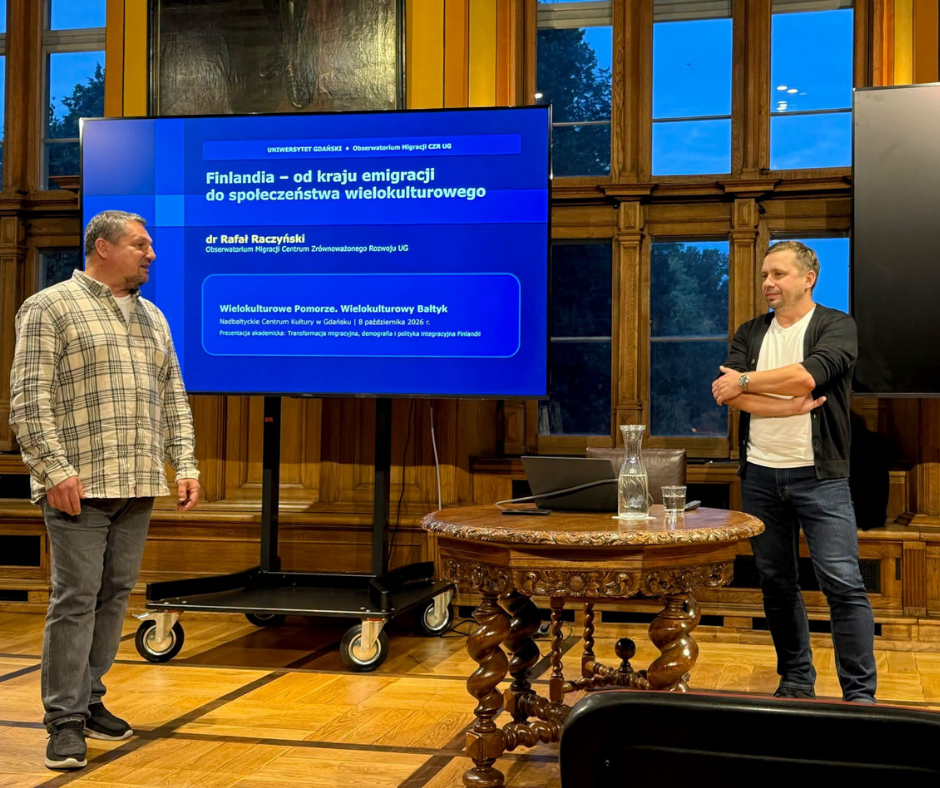
Another meeting in the “Multicultural Pomerania. Multicultural Baltic” series is behind us. For much of its history, Finland was primarily a country of emigration. It was only in recent decades that migration patterns began to reverse, with Finland gradually becoming a country of immigration and an increasingly multicultural society. On 8 October, we gathered at the Baltic Sea Cultural Centre in Gdańsk to discuss the changes Finland has undergone.
Photo: Facebook / Agnieszka Zabłocka
The meeting, entitled “Finland – From a Country of Emigration to a Multicultural Society”, was led by Dr Rafał Raczyński, Coordinator of the Migration Observatory at the Centre for Sustainable Development of the University of Gdańsk. The Observatory is a partner of the entire series.
As Dr Rafał Raczyński points out, Finland is an interesting example of a country that, in just a few decades, has transformed from a society characterised by emigration into an increasingly multicultural one.
“During the meeting, we explored the causes and consequences of this transformation, with particular attention to demographic challenges, the role of migration in the economy, and integration policies. Finland’s experience clearly demonstrates that migration is not only a response to labour market needs but also a process that profoundly transforms society, requiring long-term and well-considered integration measures,” he emphasises.