

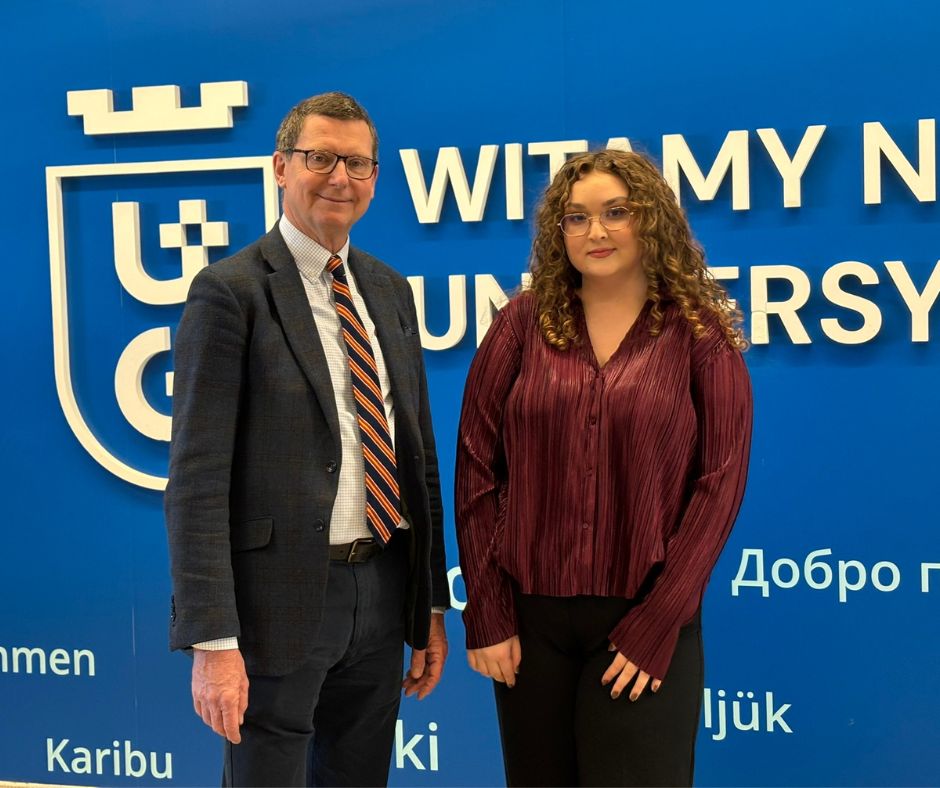
“The best ambassadors for nuclear safety are those who live near the nuclear power plant. Citizens and their representatives must trust the system. Fundamentally, it is about building security and confidence – trust in each other and the assurance that the system is designed to protect citizens from radiological accidents,” Jagoda Koszałka, a third-year student of Scandinavian Studies at the University of Gdańsk, spoke with Mats Rosén, who served as Secretary General of the Local Safety Committee of the Barsebäck Nuclear Power Plant in Sweden from 2008 to 2018.
Mats Rosén visited the University of Gdańsk in March 2025 at the invitation of the Centre for Sustainable Development (as part of the Energy Transition Lab programme) on the occasion of the Baltic Nuclear Energy Forum 2025, which took place on 18–20 March.
Jagoda Koszałka: Welcome, Mats, and thank you for taking the time to speak with me today. You were the Secretary General of the local safety committee at the Barsebäck nuclear power plant. Could you start by telling me a bit about your role and what your main tasks were?
Mats Rosén: Our main task as the local safety committee, or transparency committee, which is a more fitting term, is to serve as the public’s point of insight into the nuclear power plant. This involves overseeing their safety planning, the planning for the different operational phases throughout the year, and serving as a platform for joint discussions.
We also play an important role in communicating this information to the public. This means we receive information from the nuclear power plant, analyze it, and present it to the public. We have done this regularly through articles in local newspapers and on our website.
Why do you say that the transparency committee is a better name for this authority?
There was a motion from a Member of Parliament in 1981, the year after the referendum on nuclear power. The proposal was to establish an independent body that would not be part of the authorities responsible for controlling nuclear power. Issues concerning nuclear safety and radiation safety are the responsibility of state agencies.
However, the proposed authority, appointed by the government, would focus on local matters. Municipalities within the inner safety zone – up to five kilometers from the nuclear power plant – would have the right to nominate representatives to a safety committee.
The aim was to create transparency, but the word “safety” was chosen because it related to nuclear safety. At the same time, it’s important to understand that there is only one party that bears the ultimate responsibility for safety at a nuclear power plant – and that is the operator of the plant. Therefore, it is the operating company that must take on this responsibility.
At the top of the organization, you have the board, CEO, and management. As I mentioned during the seminar we just had with students here at the university, a sustainable nuclear power plant is characterized by a strong safety culture. This must permeate the entire organization, all employees, and especially the management. Everyone works toward the same goal: ensuring that safety always comes first.
All other goals for the operation, such as turnover or the number of hours produced, are secondary. They must never take precedence over safety – which is about protecting people, the environment, and nature.
When it came to making decisions, did you follow any set procedures, or did you adapt depending on the situation?
Yes, it is definitely situation-dependent. If a minor incident occurs – something that isn’t serious but still significant – it becomes a central point of discussion during the meeting. The safety committee meets every month or every other month.
During the meeting, the CEO or an appointed representative from the nuclear plant presents a safety report. All incidents, regardless of their scope, are brought up. It could be something as simple as someone forgetting to lock or close a door – and it doesn’t even have to be near the reactor.
Everything related to physical protection and radiological protection is discussed. In the case of radiological incidents, for example, it could be a situation where water with low radioactivity is accidentally spilt during cleaning. Such events must be recorded, and in a nuclear plant with a well-functioning safety culture, everything is documented meticulously. Any deviation is noted – even something as small as someone falling down a staircase. Any deviations concerning people, technology, and organization, the three main areas within safety culture analysis, must be documented.
One example is the decommissioning of the Barsebäck nuclear plant. During the dismantling phase, a situation arose where radioactivity spread in a space where decommissioning was taking place. It became a learning process because no one had previously decommissioned a nuclear plant in Sweden. We in the local safety committee visited several plants in Germany where nuclear plants had been decommissioned, and we discussed experiences with those who had been involved in the process.
During decommissioning, old remnants of things can be discovered, as well as consequences of past incidents that weren’t known until the dismantling began. Radioactive substances are often bound by water, which in turn seeks out the lowest points – typically reinforced concrete. The concrete can be shielded, but outside the inner containment structure, exposed concrete is common. Water tends to collect in pools there. Inside a nuclear plant, temperatures are high, and there are many pipes containing steam, which contributes to the condensation of moisture. This condensed water can, in some cases, have captured remnants from previous incidents, which are released when the dismantling begins.
When this happened at Barsebäck, it became the highest priority on the agenda at the next meeting with the local safety committee. We requested an explanation for why it occurred, and at the same time, the incident was reported to the regulatory authority, the Swedish Radiation Safety Authority (Strålsäkerhetsmyndigheten), which is responsible for nuclear safety and radiation protection within the nuclear industry in Sweden.
And we were able to share their response and comments. Then we also wanted the authority’s analysis of the situation. What could have been done to prevent it from happening? This is about prevention, learning, and sharing lessons with others. No harm was caused, but the high radiation dose meant that the individuals exposed could not continue working. There is a limit to how much radiation an individual can be exposed to per year. When someone approaches that limit, they are removed from duty within the safety zone, the so-called inner zone of a nuclear plant.
A nuclear power plant is divided into different safety zones. First, there is an outer wall and a fence, followed by an extensive inner area. In Oskarshamn, for example, this area spans several kilometers, whereas in Barsebäck, it was significantly smaller. Inside the area, one eventually reaches the specific nuclear reactor part. When entering the facility, you begin in a non-radiation zone, where there is no radiation present. Afterwards, you change clothes and step over a clearly marked barrier where you must put on protective clothing. This boundary is strictly enforced, regardless of whether the reactor is operational or not. The safety culture remains the same – whether you’re at Barsebäck, Forsmark, Gundremmingen in Bavaria, or Tokai, east of Tokyo. This is true in all the nuclear power plants I have visited, the culture is exactly the same.
This is important to emphasize because it is one of the most central aspects to communicate. There is a global standard for how a nuclear power plant should operate safely – for the people who work there, for those living nearby, and for nature.
Therefore, everyone must adhere to this safety culture, and this is done consistently. For example, nothing that has been inside the protected zone – whether it’s dirty or not – is mixed with material outside the zone. Washing and handling of items is done according to specific procedures.
This very safety culture is what we, the local safety committee, are tasked with communicating to the public. We have insight – something that most others lack. We were among the few who were allowed access even after the nuclear power plants in Sweden were shut down after 2011.
After the incidents in Fukushima, strict restrictions were introduced, and the consequences for Europe were, in my opinion, devastating. Germany decided to shut down all its plants within one day. What was initially said to take ten years ended up taking thirteen years, which led to large amounts of energy being taken offline.
Today, we can clearly see what the energy transition means. When Germany chose to take a shortcut by relying on cheap Russian gas, they became vulnerable. Now, when the gas is no longer available, we see the consequences – higher electricity prices in both Poland and Sweden.
This is an example of short-term decisions that lack long-term safety culture. It was a short-term political decision, rather than a safety-based one, made by the then chancellor. Even many politicians within the same party in Germany are questioning the decision today.
Safety culture must be sustainable over time. It cannot be influenced by which government is in power, who the CEO of the energy company is, or which local leadership is in charge.
The concept of a host municipality is central in this context. Without a host municipality that feels seen, involved, and listened to, it is impossible to run a nuclear power plant. Citizens and their representatives must trust the system. Fundamentally, it is about building security and confidence – trust in each other and the assurance that the system is designed to protect citizens from radiological accidents.
This is not work for a single secretary. It is actually my members – those politically appointed and nominated locally by the ministry – who bear the responsibility. My role is to facilitate their work by providing them with the right information and resources to manage communication. My task has been to dive deeply into nuclear power, technology, and the issues related to the operations, often more than my chairman and members have the opportunity to do.
It is not a local mayor’s primary task to possess this expertise. However, over time, I have seen that the mayors and municipal councillors working in nuclear municipalities develop deep knowledge of the subject. Regardless of where they come from, they have vast experience because, like me, they understand that security and trust are crucial for the safety of the residents. To achieve this, they must immerse themselves in the issues, read up, and make well-informed decisions.
Therefore, they often engage deeply in the subject because it is such a critical area. If nuclear power doesn’t work properly, it affects everything.
When it comes to the committee members and structure, is there a clear division of responsibility in a crisis situation? Is it clearly defined who activates a crisis management team and how the information should be communicated to the public?
This is not the responsibility of the local safety committee. The responsibility for this lies with another authority, and it will be handled at the regional level in Pomerania as well.
In Sweden, we have two regional levels. The state level is represented by the District Administrative Board (Länsstyrelsen), while the regions are elected by the public. However, the elected officials have only limited insight into the process and are not actively involved. The management responsibility lies with the District Administrative Board.
There is continuous dialogue between the District Administrative Board and the local safety committee. However, the committee is not responsible for preparedness, such as evacuation or other measures – that is the responsibility of the municipality.
The state funds these efforts and transfers the funds to the municipality, which then decides how to implement them. This can either be done through the municipality’s own resources or by external actors, depending on the situation.
The local safety committee does participate in the dialogue concerning the inner and outer security zones, which extend 5 km and 25 km, respectively. The inner security zone is the area that needs to be evacuated in the event of an incident, so the municipality must be involved in the planning.
In practice, this means that many people from the municipality’s executive leadership also sit on the local safety committee. It is not always exactly the same individuals, but there is a clear overlap. Therefore, they are fully aware of their different roles and responsibilities when transitioning between representing the independent authority, the local safety committee, and the municipal board. This enables us, from the committee’s side, to highlight when something is unreasonable or requires change. For example, that we need more buses and better preparedness for a potential evacuation. Additionally, increased funding is needed to meet these needs. If we increase the output of an existing reactor, it also increases the risk, which in turn requires more safety measures.
For example, improved fire safety may be needed, and in that case, additional funds must be allocated from another budget. These costs should not burden the local economy, but instead, the nuclear power plant should cover them, as it is the one increasing its revenues by taking on a higher risk.
But this means that we might need to invest more in fire safety. In that case, funds may need to be added from another source. And that should not affect the locals, but someone else should pay for it.
And that, of course, would be the nuclear power plant, because it is they who are increasing their revenues by taking on greater risk. Whether that is good or not is not determined by the local safety committee or the municipality. That is decided by the regulatory authorities, in this case, the Radiation Safety Authority.
However, the consequences are felt locally. And this is the dynamic that always exists in this context. And no matter which country you’re in, it will always be the case.
Because everyone wants to optimize their own budgets and fine-tune them. They don’t want to bear the costs resulting from someone else’s decisions. It is important to keep these things separate.
At the same time, it is important to remember that this is a continuous negotiation. You never find a ready-made solution for how it should be.
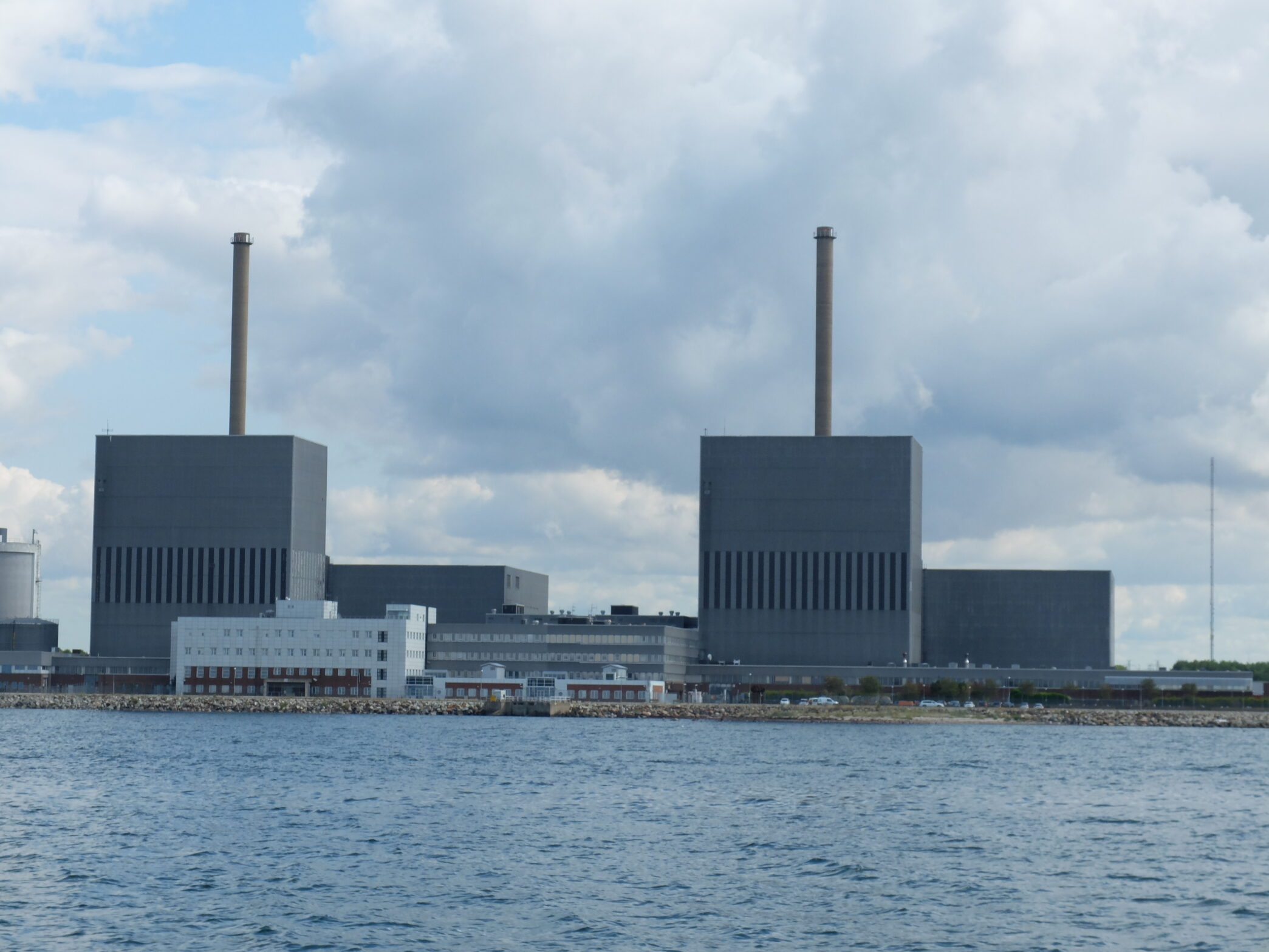
Barsebäck Nuclear Power Plant. Kävlinge municipality coastal. Photo: Mats Rosén. All rights reserved.
I assume it’s crucial that everyone involved in the nuclear power plant knows exactly what to do in an emergency. Have you therefore carried out any realistic drills to test this in practice?
Yes, we carried out an evacuation from the inner safety zone at the Ringhals nuclear power plant, under the leadership of the District Administrative Board of Halland County. It was a process based on several years of planning.
It turned out that it was often the small and seemingly trivial details that caused problems—the very little things everything got stuck on. Ideally, an evacuation should be avoided. The best course of action is to stay indoors, close vents, windows, and doors, and wait until the elevated radiological levels outdoors have dissipated.
As soon as people leave their homes, someone else becomes responsible for arranging care—that is, accommodation, food, toilets, sleeping places, and so on. This is not something easily solved. In our culture, it is really only in wartime that we have any experience of such situations. We haven’t experienced anything similar in modern times in Europe—except for Chernobyl.
But conducting such exercises clearly shows how vulnerable we really are. It becomes very clear. All of a sudden, every basic need in Maslow’s hierarchy of needs must be met—just because people are forced to leave their homes.
The consequence is that those at risk of being exposed to dangerously high radiation doses, where it is not possible to prevent air from entering homes and carrying radioactive isotopes, should actually remain indoors. And in such a situation, everyone knows what to do.
You can’t go to work, can’t take the car and drop off the kids at daycare—you simply have to stay home. But for those not within the zone, and who must be retrieved from there, an enormous amount of planning and different strategies are required.
I can only say that it has been a sobering experience during the years I’ve been active in this work. We’ve visited Chernobyl several times—both shortly after the accident and many years later. I myself arranged trips where we, among other things, invited mayors from Spain to join, in collaboration with the University of Kyiv. On one of these occasions, we visited Reactor 4.
We also visited the nearby municipality, and that’s when I truly realized why a local safety committee is so important. It creates a platform for dialogue on equal terms—where the municipal council leader is not subordinate to the CEO of the nuclear power plant or their safety advisor, but where everyone knows each other, and knows that in the event of an incident, you call directly. ”You must now notify everyone living in this part of the municipality that something has happened. Stay home. Close everything.” Before even calling the other authorities, certain measures need to be initiated. But in reality, that takes hours. Had they acted like that in Chernobyl—without waiting for permission from the General Secretary of the Communist Party in Moscow—several deaths could have been avoided.
If they had just called Pripyat directly, which was a kilometer away, they could have acted faster. The accident occurred on a Thursday, but the evacuation didn’t happen until Saturday. We know today that several deaths were linked to this delay.
People didn’t take iodine tablets; they continued to eat fruit and other things from the outdoor environment. The radioactive material entered their bodies. Many of those who died were young. When the wind shifted and spread the radioactive cloud, evacuation began, but by then it was already too late for those in the path of the wind. There simply was no communication.
And that is exactly my point: someone just needed to pick up the phone. That’s why we need a local transparency committee—a platform where people get to know each other and understand that safety work is a shared responsibility. Had that existed in Chernobyl, the worst consequences could have been avoided. The accident caused a social trauma that lingered long after the radiological danger had disappeared. People continued to live with the fear. ”Why didn’t anyone call? Why didn’t anyone say anything?” The mayors had no idea what was happening. People just went on with their daily routines—went outside, raked leaves. It was spring, and they were preparing for the First of May celebrations. But at the same time, they were being exposed to radiation—without even knowing it.
Based on your experience – which methods of fast and effective communication work best when it comes to reaching the public in everyday situations?
I have to say that things have changed quite a lot. In the past, I would have said that mass media was the key. But now we have new generations who never watch TV, never listen to any state radio channel, and would never visit a municipal website – or read anything from the nuclear power plant, the Swedish Radiation Safety Authority, or the local or regional safety authority.
So how do we communicate with them? We need to find new ways in such situations. And that’s something many communicators in the security field are working intensively on. Where can we actually reach people? It’s partly about quickly reaching certain key individuals who can, in turn, act as information spreaders.
Because in such a situation, a flood of rumors can easily arise – rumors that aren’t true. And during an evacuation, that can be one of the most dangerous things. Why? Because we might face resistance from antagonistic individuals or states who spread misleading information with the intent of sabotaging the evacuation. They might, for instance, claim that evacuation isn’t necessary, or on the contrary, spread panic and say that it’s not possible – that roads are blocked and so on. This creates distrust – and that is the most dangerous aspect in such a situation. That’s why it’s so difficult to give an exact answer to your question. Because the situation looks entirely different today compared to when I started working in this field. In 2007–2008, the internet and platforms people followed did exist, but you can’t compare that to the reach of social media today. The social platforms that existed back then don’t even exist anymore. They were youth sites, more like small “tribes” centered around things like music taste. Today, completely different actors are involved.
And the most tragic part is that if we rely on social media, we’re essentially placing our communication in the hands of actors who may not necessarily have good intentions. These could be global tech companies, even national interests, with their own agendas. We see how American platforms are increasingly distancing themselves from European issues. That means if we use these media channels, we’re relying on a system that can arbitrarily remove content – under the pretext of it being “fake news.”
So, we’re currently in a very uncertain situation when it comes to communication.
So, we’re talking about 2025 – and it’s all about boiling it down. The message communicated by the municipality, supported by the local safety board and the local nuclear power plant, must be clear. I wouldn’t say it’s like shouting into the void, but you have to be consistent. It’s about maintaining the message over time and hoping that it spreads organically.
Within the protection zones – that is, the inner and outer safety zones – there’s already a model: each household has a special alarm, an RDS radio, that enables direct communication. When it turns on it stays turned on until the distress messages have been delivered. You can’t turn it off. The information broadcast reaches the residents directly, and these residents in turn become ambassadors for further dissemination. And that’s something we’ve learned: the best ambassadors for nuclear safety are those who live near the nuclear power plant. Trust in these areas has consistently been above 90%, and it’s precisely those who live with the plant in their everyday lives who feel the greatest sense of security. Why? Partly because they see the facility every day – it’s impossible to miss – and there has never been a serious incident, so they’re content. But perhaps the strongest reason is the social aspect: within one or two degrees of acquaintance, you always know someone who works there.
That person becomes a natural ambassador for the prevailing safety culture, and even if you’ve never met that employee directly, you’ve met their neighbor, their children, or someone else who’s shared their perspective – and that makes an impact. You get the impression that these are people who take their responsibility very seriously. Everyone communicates the same thing, and that makes the safety culture permeate the entire community.
That’s why it’s so important for nuclear power plants to understand that their greatest asset is the people who live nearby. These citizens are not just recipients of information – they are carriers of the safety culture. Through long-term presence and responsibility, the nuclear plants have managed to create a culture that has, over time, become integrated into the local society.
When opponents of nuclear power present arguments that aren’t true, it’s often the citizens themselves who speak up and push back: “No, I know, because we understand the safety culture. We live here, and we share that culture.” Their safety culture becomes our culture too.
My next question might take things in a slightly different direction. I imagine that during your time on the local safety committee, you’ve had to answer countless questions. Are there any questions you think the public should be asking more often? And are there any you’ve been asked so many times that you could almost answer them in your sleep?
Yes, the most common question I get – and not from local residents, but rather from outsiders – is: “But it is dangerous, right?” And yes, splitting atomic nuclei is inherently dangerous. That has to be acknowledged. What’s interesting is how it all started – under a stadium in Chicago, of all places. It was so unlikely that no spy could have believed something so dangerous was happening there. They had no idea what they were doing back then. But today we do.
Science and engineering have developed a stable and reliable system for managing a controlled reactor core – that is, the place where the actual process occurs, where uranium is split and neutrons are released to continue the chain reaction and produce heat. It’s the energy generated in that process that can be dangerous – but only if it escapes the controlled environment. That’s why we encase the core in multiple layers of safety. We want to keep it contained.
But the question I think people should ask more often is: “How do you build a strong relationship between the local community and the nuclear power plants?” And our answer to that was to create meeting points together with the community. We took part in spring and autumn markets and met with the public once or twice a year. We set up booths, talked, answered questions, and could directly address any concerns. It made a big difference. People could go home and feel like, “We met them – they told us the plant is now in this phase.”
For many years, we were in a decommissioning phase – not demolition in the traditional sense, but systematically dismantling the reactors. Two reactors have now been completely dismantled, and there’s basically nothing left of them. Everything has been cut down into smaller parts and placed in so-called coquilles – special containers designed to store medium- and high-level radioactive waste. And in that process, a number of important questions arise that we need to keep talking about: ”What are they doing in there?”, “Why does it take so long?”
The answer is that the entire facility is taken apart, piece by piece. Everything is cut down to pieces no larger than ten to thirty centimeters. It’s all about packing everything away with extreme care. Then the containers are sealed, and in some cases even filled with cement. That’s how medium-level waste is handled. It’s a process many have wanted to understand better, and we should have gotten more questions about it. Because this is exactly the kind of work we’ve spent recent years trying to communicate.
During this period, we’ve held almost all our meetings out at the nuclear power plant. However, when the facility was still in operation, we never held meetings there — instead, we chose neutral locations. That was a deliberate choice — a way to demonstrate the authority’s independence. We didn’t want to sit in the middle of the very operation we were supposed to oversee. But during the decommissioning phase, the opposite became important: being on-site, seeing how the safety work was carried out in practice, especially now that the risks were significantly lower. Once the last reactor rods had been removed, there was no longer any radiation source on site — and that made it especially interesting to follow how the actual dismantling was done.
Dismantling a nuclear power plant is a massive undertaking. Everything is taken apart: metal sorted separately, radioactive materials separately, concrete separately. Several centimeters of the innermost concrete in the reactor containment are cut away — it’s a precise and time-consuming task. And it’s expensive. That’s something we often want to highlight: all of this is already financed. Nuclear power covers its own costs. During the production phase, funds are allocated to the Nuclear Waste Fund — and that fund is replenished each year. That’s how the system works.
We’ve seen that the decommissioning costs have been higher than initially planned. In Sweden, however, hundreds of billions of kronor have already been set aside in a fund — which stands in stark contrast to, for example, the UK, where nothing was set aside. Now, the entire cost falls on taxpayers there — but Sweden showed foresight. The nuclear power industry also took responsibility early on by forming a joint company, SKB (Swedish Nuclear Fuel and Waste Management Company), which covers all five nuclear sites.
SKB has been responsible for all planning regarding how and where the spent nuclear fuel will be stored. They’ve also handled the entire process of dialogue with municipalities interested in hosting the final repository. It was never a case of the government simply pointing to a location. Instead, they examined the geology, but ultimately decided that the most important factor was local acceptance.
In the end, two municipalities competed to host the repository: Oskarshamn, with its three reactors and an interim storage facility for spent nuclear fuel, and Östhammar, where Forsmark is located with its three reactors and an existing repository for low-level waste. The final choice fell on Forsmark, partly because the bedrock there — the so-called ”Swedish Bedrock” – is considered one of the most stable and secure in the world. The Scandinavian bedrock, stretching all the way down toward Pomerania, is free from earthquakes and other geological risks, making it ideal for long-term storage.
But these questions — about why it was chosen and how the decisions were made — rarely came up in public discussion. Instead, the process has been dominated by technical appeals, environmental impact assessments, and court proceedings. But those aren’t the questions we should be asking. The important questions are about trust, transparency, and long-term safety. That’s the kind of dialogue we need more of when we talk about final repositories for nuclear waste.
I’d like to discuss the structure of the committee, because I’m curious about how it is organized and how the balance between the different participants looks. What are the relationships like between representatives from local authorities, municipal officials, nuclear investors, operators, residents, and other groups?
Can you explain how the internal structure of the local safety committee works?
Unlike other countries, where stakeholder groups are more loosely organized, in Sweden, we have a government agency structure. We have a central government that governs, and the committees are independent agencies under a ministry, whose minister is part of the national government. This means there is no possibility for external actors to be directly involved in the committee. Instead, the committee’s task has been to create meeting places and to invite and be invited to discussions. These meetings have been held at various local places such as Lions (an international charity), environmental associations, and other similar communities.
It has always been important to maintain distance from becoming politically exposed, which Barsebäck became — perhaps the most politically charged nuclear power plant in Sweden. This was due to the Danes changing their stance on nuclear power in the 1970s, becoming strongly anti-nuclear, and through activism from Greenpeace, an intense lobbying campaign was directed toward Stockholm. Greenpeace acted as the spokesperson, flying in helicopters, landing on a reactor building, and unfurling a large banner with the message “Lukketid” – time to close.
The most crucial factor was that the decision to shut down Barsebäck was made as a political decision in a government negotiation in Stockholm, where a political party pushed for arguments based on these external pressures. The consequences are visible today, where the energy produced in southern Sweden is insufficient, resulting in electricity prices being 10-100 times higher than in northern Sweden.
Our structure follows a classic committee model, which means we have the usual representatives and substitutes – making us quite a large group. We’ve arranged a number of study trips because we believe it’s instructive to see how work is carried out in other places. We’ve visited several cities and familiarized ourselves with different methods, such as the French Euclid method and the German model, where cooperation primarily occurs between mayors and nuclear power plants – a very small group, not particularly inclusive of other stakeholders. In the UK, we saw a broader stakeholder group where even critics are invited and managed, but this also means these groups sometimes get their own agenda. The focus shifts from safety for those living near the plant to becoming a tool for someone else’s political purposes.
We’ve chosen a simpler structure, which in theory allows for open meetings for the public, but the interest has been very low. In a municipality with over 30,000 residents, it can happen that only one or two people show up, despite careful planning, booking a venue, and ensuring the meeting is held on neutral ground – neither at the municipal hall nor at the nuclear power plant. This has been the case not only with us but also with colleagues in the other four committees. However, in Sweden, there is strong trust in nuclear power, and this trust has actually increased, especially as more people have become positive about building new nuclear plants when they see the consequences of not having enough energy production – something that reminds one of the situation in Poland.
I want to highlight that our simple committee structure, with its regular meetings and clear communication channels, actually works. We publish articles after our study trips and always strive to be a neutral party that conveys information based on what we interpret citizens need – to create security and trust.
And when it comes to financing, how does it work? Did you receive any funding from the government, or were there other sources of financing?
In Sweden, it has been decided that the local host municipalities do not receive any funds from the nuclear power plant. We get nothing – there is no local tax linked to them. There is also no fund established. This has been the case until we started discussing the issue of nuclear waste and where it would be located.
When the committees were established, a budget was set, and it has remained the same since then. But there is not much left of it now – after all, it has been 40 years. In the mid-1980s, when all the committees were introduced, the budget was set at 400,000 SEK per year. How much is that in zloty?
40 000 euro or 150 000 zloty.
Yes, there you have it – 40,000 euros. That’s the entire budget. It’s only enough for certain fees, such as for the chairman and the secretary. But it’s not a level you can live on. The largest financier has, in practice, been the local municipality, which has provided part of the service. And if you’re at a managerial level, there’s no overtime – you work as much as needed. In this way, the committee has partly been able to rely on the municipality, but always in the municipality’s own interest. It has never been about a cost, but about an investment in commitment and local responsibility. And I haven’t been alone in this.
Several other municipal departments have been involved in issues related to the nuclear power plant – the technical committee, the urban planning committee in planning and building permit matters. All of this has contributed to building up a broad competence around nuclear power, safety, and related technical issues.
The 400,000 SEK has primarily gone to small expenses and study trips. Resources were pooled together, enabling a few larger trips to study how decommissioning and deconstruction have been handled in other countries. This has been very valuable, as it has direct consequences for how we handle these issues here.
When such a massive facility is being decommissioned, large amounts of material need to be transported away. Nuclear waste accounts for less than five percent – in fact, only a fraction. The most technically complicated part is the radioactive, irradiated material, such as stainless steel and the containment around the reactor itself. That’s perhaps five percent of everything.
The rest is mainly concrete with no radiation, which must be transported away or filled in. A nuclear power plant is often as deep below the ground as it is tall above it. If it’s seven to ten stories tall, it’s also seven to ten stories deep – that’s where all the piping systems, water intakes from the sea, go in and out through the Öresund Strait.
All of this must be filled in during decommissioning. People often talk about “brownfield,” but we’ve advocated for it to become “greenfield” – that is, land that can be used for farming or other non-industrial purposes in the future. Alternatively, a sufficiently sanitized “brownfield” for new industrial activities.
We have always felt that the funding has been on the low side. My fee essentially amounted to one day’s compensation per month compared to my regular work – even though one often spent several full days on-site, for example, in Öresund. Much of the planning also fell to others, so you worked in addition to your usual duties. It was in that order – actually, not even a full day’s fee. But I never saw it as a cost. For me, it was an investment, and I have really appreciated working on this.
My last question is this: When can one actually say that the committee’s work is finished? Can you ever say that you are done?
Earlier, the legislation was such that the committee’s work continued until the entire area was decommissioned – meaning until there was no longer any radioactivity, and the owner was satisfied with being able to retain the building and repurpose it for something else.
Until that day, there was a local safety committee, although its responsibilities naturally diminished as less activity remained. The government decided to disband the safety committee at Barsebäck even though the outer structure had not been demolished, only the internal parts.
So, starting in 2023, the committee was disbanded. The decision to close it was made in 2022, we were formally decommissioned in 2023, and in 2024, it was officially clear that we were dissolved.
I was then responsible for taking care of our entire archive and transporting it to the National Archives’ depot in Lund, where such an archive center exists. When I received confirmation from the National Archives that they had received everything – then it could be said that the committee was completely finished.
Okay, and that’s all from me. A big thank you – really – for sharing this. I believe it’s very valuable, both for us and for Pomerania.
Thank you for having me here and a big thank you to you for interviewing me in Swedish. With such great Swedish, it’s truly wonderful to hear.
Thank you a lot!